WP3 — Scheduling of DERs for Resilient Operations of Distribution Grids (Final Report)#
Authors
Fabrizio Sossan, Plouton Grammatikos, Noureddine Id Omar, Stefano Cassano — December 12, 2025
1. Introduction#
1.1 Context and WP objectives#
The integration of Distributed Energy Resources (DERs) — such as photovoltaic (PV) plants, electric vehicles (EVs), and battery energy storage systems (BESSs) — into residential and commercial behind-the-meter installations has transformed traditionally passive consumers into active prosumers. These prosumers can exploit the flexibility of their DER portfolios to enhance behind-the-meter performance — for example by minimizing electricity costs, increasing PV self-consumption, and performing peak shaving. Beyond local benefits, coordinated DER operation can also support power system operation, particularly when appropriate remuneration mechanisms are in place.
Grid support may take multiple forms. At the transmission level, DERs can contribute to ancillary services for the Transmission System Operator (TSO), such as balancing power provision. At the distribution level, they can assist the Distribution System Operator (DSO) with congestion management and voltage regulation. Crucially, coordinated DER scheduling can also enable or enhance the capability of distribution grids to operate in islanded mode, allowing parts of the network to remain energized and supply critical loads during upstream outages or disturbances.
The objective of this work package was to explore and propose methodologies for the optimal scheduling of DERs in distribution networks, with the dual aim of providing grid services under normal operation and supporting reliable and efficient islanded operation when required.
In this project, we have addressed price-based control of prosumers in distribution grids to achieve coordination of DERs. Specifically, we developed an algorithm that uses the Alternating Direction Method of Multipliers (ADMM) to solve a linearized Optimal Power Flow (OPF) in a distributed way; the algorithm computes a nonlinear price signal capable of steering the consumption of price-sensitive prosumers to restore proper operation of the distribution grid in terms of line current and voltage levels. The algorithm is general and can be applied to control different types of energy resources without requiring modifications. The optimization-based formulation is likewise general and can be extended to include off-grid (islanded) operation capabilities.
This work package contributed to the following publications:
- P. Grammatikos, A. M. Ali, and F. Sossan, “Formulation and experimental validation of price-based control of flexible prosumers in distribution grids with the alternating direction method of multipliers,” arXiv preprint arXiv:2511.15318, 2025. (Under review in Sustainable Energy, Grids and Networks, Elsevier.)
- N.-e. Id Omar, C. Dorsaz, T. Rey, D. Blatter, S. Dervey, P. Jessen, and F. Sossan, “Control and scheduling of behind-the-meter battery energy storage systems for providing services in a smart building context,” Conference on Sustainable Development of Energy, Water and Environment Systems (SDEWES), 2025.
1.2 State of the art#
Control strategies for flexible prosumers are commonly categorized as direct or indirect. In direct control, power setpoints are explicitly defined to control resources; in indirect control, an incentive signal is communicated to influence generation and consumption levels. More recent definitions refer to explicit and implicit flexibility.
A common form of indirect control — and the mechanism investigated in this project — is price-based control, in which dynamic electricity tariffs incentivize consumption (or generation) shifts under the assumption that consumers aim to minimize costs. Time-of-Use (ToU) tariffs are a typical example, implemented to shift demand to off-peak periods. Real-time electricity markets extend ToU by incorporating dynamically adjusted prices that vary based on the available renewable generation. Compared to other strategies, price-based control is easily understood by prosumers and offers them a clear economic incentive to adapt their consumption. However, existing schemes such as ToU and real-time pricing often neglect distribution grid constraints. As a result, low or high prices may synchronize prosumer behaviour in ways that could overload the distribution grid.
In transmission grids, Locational Marginal Prices (LMPs) — derived from the Lagrange multipliers of the OPF constraints — are used to compute nodal electricity tariffs that reflect transmission constraints and local generation. Several studies extend LMPs to distribution grids by using these multipliers to adjust electricity prices in the OPF objective, encouraging prosumer demand shifting. Other works refine these multipliers further by adopting quadratic cost functions to avoid solution multiplicity. Similarly, we leverage the OPF formulation to compute dynamic tariffs for prosumers, incorporating the multipliers into a quadratic cost function to improve convergence. Compared to existing approaches, we adopt a distributed formulation that separates grid operators from prosumers, preventing the direct exchange of sensitive data.
Existing methods can also be classified by the grid model used: linearized models, or approximated non-linear ones (which are more accurate but harder to solve). In our approach we adopt linearized grid models because, as discussed in the companion paper, they lend themselves naturally to a decomposition according to the ADMM paradigm. The grid model is improved at each iteration through sequential linearization, which limits the effect of model inaccuracies on the optimal solution and constraint satisfaction.
The scheduling of islanded microgrids has been extensively investigated, particularly in the context of rural microgrids.
2. Scheduling of DERs in grid-connected and islanded mode#
2.1 Problem statement#
This section presents the formulation of a scheduling problem for DERs that covers both grid-connected and islanded operation.
The considered scenario involves a grid operator (a DSO) that can directly control the controllable resources within the distribution network in order to maximize social welfare. Social welfare is defined differently depending on the operating mode:
- in grid-connected operation, it is associated with electricity prices;
- in islanded operation, it reflects the ability of the system to sustain supply (e.g., survival duration, or expected load not served).
The proposed formulation is based on an optimization problem that steers the flexibility of DERs to meet the operational objectives of the system. Owing to its generalized structure, the formulation can accommodate both grid-connected and islanded operation. Under grid-connected conditions, DERs are scheduled to minimize operational costs, primarily driven by the cost of electricity exchanged with the upstream grid. In islanded mode, DER operation is subject to the additional constraint of zero power exchange at the point of common coupling, ensuring autonomous operation of the microgrid.
The grid operator is assumed to be omniscient with respect to grid conditions and the controllability of available resources. An extension of this centralized formulation to a distributed, privacy-preserving approach is presented in the companion paper, where information-sharing requirements are significantly reduced.
2.2 Settings and notation#
We consider \(N\) prosumers connected to a low-voltage distribution grid (e.g., Fig. 1). Each prosumer \(i \in \{1, \ldots, N\}\) has a set of \(M_i\) behind-the-meter energy resources producing or consuming power. We further consider \(K\) discrete time steps, indexed by \(t_k \in \{t_1, \ldots, t_K\}\). Let \(\mathbf{x}_{i,t_k} = [p_{i,t_k}, q_{i,t_k}]^\top\) denote the vector of the total active and reactive power demand of prosumer \(i\) at time \(t_k\) (a negative demand denotes power generation).
The full time series for the power demand of prosumer \(i\) across the \(K\) time intervals is denoted by
where \([\,;\,]\) denotes vertical concatenation. \(\mathbf{x}_i\) is a \(2K\times 1\) vector consisting of the total active and reactive power demand for each time step. Furthermore, the \(2K M_i \times 1\) vector
denotes the demand over time of each resource \(j \in \{1, 2, \ldots, M_i\}\) of prosumer \(i\), where \(\tilde{\mathbf{x}}_i^{j}\) collects the power demand of resource \(j\) for all times. The sum of the power demand of all resources equals the total demand of the prosumer:
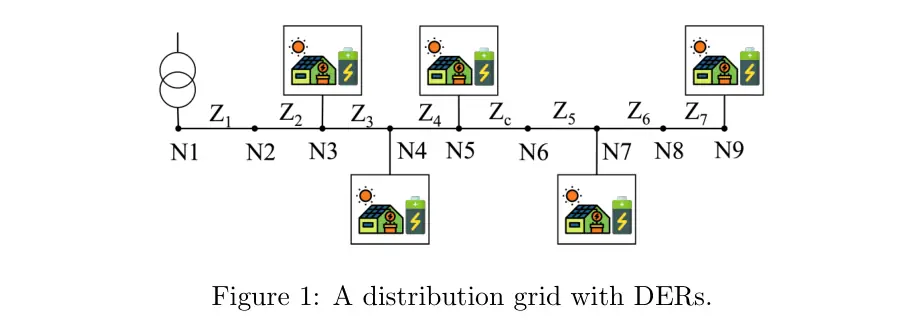 Figure 1: A distribution grid with DERs.
2.3 Formulation of the scheduling problem#
2.3.1 Generalized formulation#
Let the vector \(\mathbf{c}' = [c_{t_1}, \ldots, c_{t_K}]^\top\) represent the retail electricity price (e.g., in CHF/kWh) for each time interval. The electricity costs for prosumer \(i\) within the period from \(t_1\) to \(t_K\) are \((\mathbf{c}')^\top \mathcal{S}\mathbf{x}_i\), where \(\mathcal{S}\) is a transformation matrix that extracts the active-power components from \(\mathbf{x}_i\). Defining \(\mathbf{c} = \mathcal{S}^\top \mathbf{c}'\), the centralized optimization problem reads:
where \(\mathbf{f}_i^{eq}\), \(\mathbf{f}_i^{ineq}\) are vector functions representing the equality and inequality constraints of prosumer \(i\), while \(\mathbf{g}^{eq}\), \(\mathbf{g}^{ineq}\) represent the DSO constraints (through the load-flow equations). For the problem to be convex, the \(\mathbf{f}_i^{eq}\) must be affine and the \(\mathbf{f}_i^{ineq}\) convex — both of which can be enforced by design. The convexity of the DSO constraints cannot be guaranteed because of the non-convexity of the power-flow equations, so a linearized grid model is used.
2.3.2 Example of prosumer constraints#
Prosumers are equipped with a BESS with rated power \(s_i^{b,\max}\) (kVA) and energy capacity \(E_i^b\) (kWh). For simplicity we assume unitary round-trip efficiency and that the BESS can deliver active and reactive power within the limits imposed by the rated apparent power. The state-of-charge (SoC) at time \(t_{k+1}\) is approximated as
where \(\mathrm{SoC}_{i,t_1}\) is the initial SoC, \(p_{i,t}^{b}\) is the BESS discharging power at time \(t\) (negative if charging), and \(\Delta T\) is the day-ahead time step. The SoC must stay within configurable bounds:
The active and reactive power limits of the BESS are approximated using inner box constraints derived from the PQ circular capability curve of the converter:
Prosumers are also equipped with a PV installation, whose power output may be curtailed. Let \(p_{i,t}^{pv,\max}\) denote the active-power generation potential at time \(t\). The PV generation \(p_{i,t}^{pv}\) must satisfy
with \(p_{i,t}^{pv,\max} - p_{i,t}^{pv}\) representing the curtailment action. We assume PVs only provide active-power flexibility, so \(q_{i,t}^{pv} = 0\) for all timesteps.
The sequences \(p_{i,t}^{b}\), \(q_{i,t}^{b}\), \(p_{i,t}^{pv}\) are decision variables of the scheduling problem: by solving the optimization, the DERs’ flexibility is steered optimally to meet the problem constraints.
2.4 Grid-connected and grid-islanded mode#
In grid-connected mode, the DERs are optimized to minimize the cost of electricity, optimize PV self-consumption, or provide ancillary services to the grid. In grid-islanded mode, the optimization problem is augmented by adding a constraint that sets the power at the grid connection point \(P_t^{PCC}\) to zero for all time intervals:
This forces the scheduling problem to determine an operating schedule under zero power exchange with the upstream grid, modelling a fully islanded operating scenario in which neither power import nor export is possible. By incorporating load-shedding decisions, the scheduling problem can additionally derive optimized load-shedding strategies that extend the survivability of the islanded grid.
Note
This approach optimizes only the scheduling layer. Appropriate real-time control strategies must be implemented at the power-converter level to ensure grid-forming capability and power balancing/load sharing, typically through droop-based primary frequency control — as developed in WP4 and WP5 of this project.
2.5 Inclusion of cyberattacks#
Building on the same principle outlined above — that additional constraints can be introduced to model extra system features — cybersecurity-related risks can also be effectively incorporated. For instance, the formulation can be extended to a robust optimization framework, in which robustness margins are added to the constraints to hedge against compromised assets. This is achieved by modelling their power injections as uncertain, reflecting their unpredictability or potentially adversarial behaviour. This aspect will be regarded with particular interest in future research, building on the results generated within the RESINET project.
2.6 Results#
For experimental results, the reader is referred to the companion paper, where a control-by-price approach is proposed and demonstrated in the context of providing ancillary services to the grid, and to the SDEWES 2025 publication, which addresses the control of behind-the-meter assets for the provision of secondary frequency control. Experimental results for islanded operation are described in the WP5 report.